Considering Miles Davis and Sonny Rollins are two of my biggest musical heroes, I was surprised that Miles’ long-publicized 100th birthday morphed into a tribute to Sonny Rollins, with Sonny’s passing away just two days earlier.
I had prepared one of my adult student Jazz Lab combos for Miles 100 by asking them to choose some Miles Davis songs for their next set list. I transcribed some Miles solo excerpts during the lead-up, and was prepared to lead a deep dive on Miles. We rehearsed these tunes on Miles’ 100th birthday, and yet I had Sonny on my brain.
Miles and Sonny are on my musical hero short list for very different reasons. Miles was the king of style, of self-reinvention, of jazz minimalism, of attitude. Sonny was the master of melodic improvisation, evolving into something of a jazz philosopher, and very importantly to me, an advanced student in the art of living.
Both Miles and Sonny were victims of racial discrimination (Sonny’s father was only recently cleared of a racially motivated military conviction) and each followed a destructive early path. Miles and a young Sonny practiced music together, and they shot heroin together. Sonny himself was imprisoned in the early 1950s for drug-related offenses. But while both men kicked heroin and got their musical acts together (literally and exceptionally), it is Sonny who went on a lifelong quest for personal improvement. He worked out, immersing himself in yoga and spiritual practice. The recently published Notebooks of Sonny Rollins detail his stream of consciousness on everything from saxophone breathing techniques, to spiritual insights, and self-exhortations to stay on various strict personal regimens. Finally, Sonny took two legendary sabbaticals, the first spent practicing untold hours on the Williamsburg Bridge, and another esconced in spiritual practice at an Indian ashram.
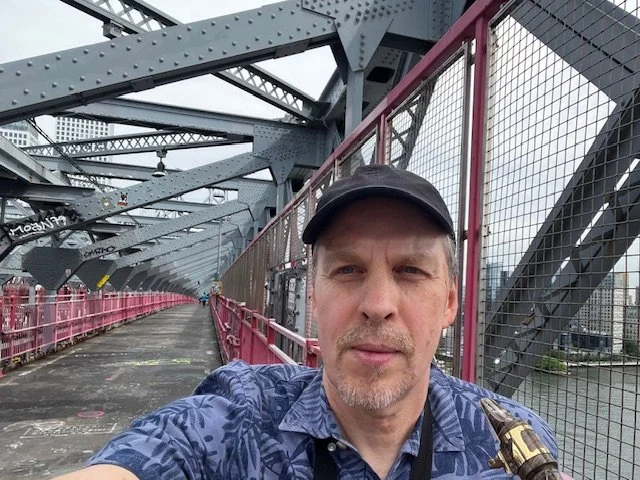
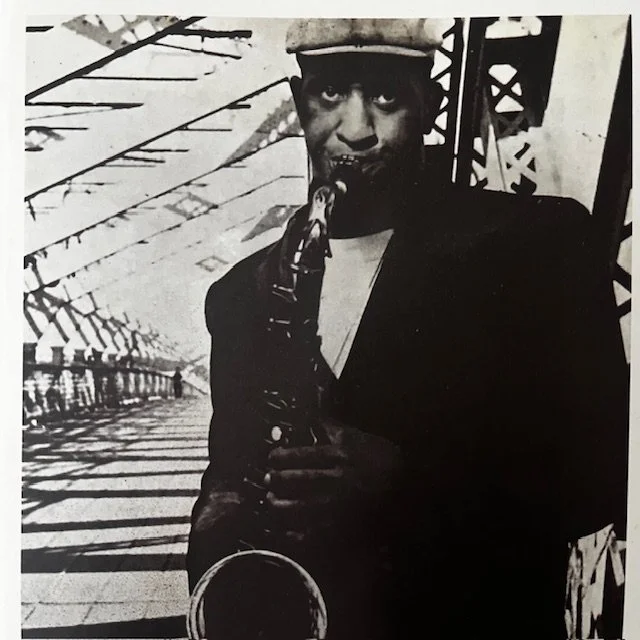
I had long planned on going to the Williamsburg Bridge whenever Sonny passed, but put off the visit until after Miles 100. And so three days after Sonny’s death, I took my first walk on the Williamsburg Bridge, hoisting a tenor saxophone, as Sonny did daily around 1959. I looked for a spot he might have practiced — he said from his favorite location he could be heard but not seen (either I couldn’t find this spot, or bridge renovations have eliminated it). I guessed from publicity photos that he may have played at the apex of the bridge — which is actually toward the Williamsburg side but over the East River, a significant walk from Sonny’s Lower East Side Apartment. This was badass on many levels: physically making the jaunt and enduring multiple hours of practicing; risking possible encounters with criminals, though Sonny was fit, and sometimes wore an imposing Mohawk; and dealing with the elements and what he described as bladder discomfort. Sonny wasn’t going to pee on a structure he considered sacred.
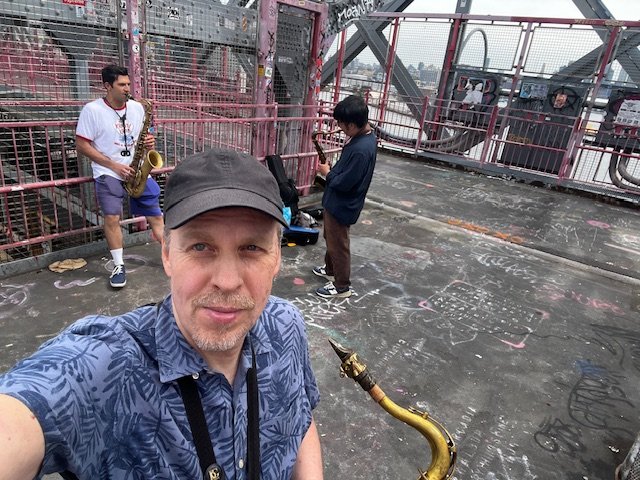
I wondered if I had the resolve to play as I reached reached the apex, where two pedestrian paths joined via a cross-bridge. And then I heard a tenor saxophone playing with two people listening. One listener, who didn’t know about Sonny Rollins, saw me approach with sax case, astonished that there were two saxophonists in the same place. He exhorted me — certainly two saxophonists had to play together! We obliged, launching into “St Thomas” and other Rollins compositions. Then a third saxophonist — none of us knew each other — turned up, and kicked off Sonny’s “Valse Hot” which I learned on the spot. As the three of us jammed at length on his “I Got Rhythm” contrafact, “Oleo,” a fast-walking man wearing headphones held his phone aloft, showing us that he was at that moment listening to Sonny’s song “The Bridge,” dedicated to this spot over the East River. We smiled and nodded in mid-phrase, in the rapture of a shared tribute.